The key points are temporarily unavailable. You can still read the full Story below.
Main Points
Recent weeks have seen a surge in public demonstrations across Europe and India, prompting editorial commentary in Urdu-language dailies regarding the nature of democratic dissent and the challenges facing modern governments. In Europe, widespread protests have erupted in countries including France, Albania, Italy, Spain, and Portugal. Reports indicate that students and youth are leading these demonstrations, citing grievances such as the rising cost of living, housing affordability, pension concerns, and deteriorating educational standards. The Hyderabad-based Siasat noted in its October 26 editorial that these protests challenge the perception that citizens in developed nations are universally content. The daily argued that the unrest reflects deep-seated public dissatisfaction with economic disparities and government policies, urging authorities globally to adopt more responsive, people-centric measures to address these grievances. In India, the discourse has centered on the political implications of protests and the government's response to them. In its October 21 editorial, the New Delhi edition of Inquilab addressed comments made by RSS chief Mohan Bhagwat during his Vijayadashami address. Bhagwat suggested that recent protests in India and abroad—specifically mentioning France, Albania, Bangladesh, and Nepal—were part of a "storm from the West" orchestrated by foreign forces seeking to undermine India’s rise. Inquilab questioned the validity of labeling domestic agitations as "foreign conspiracies," arguing that such rhetoric risks delegitimizing the democratic rights of citizens. The editorial emphasized that protests regarding electoral processes and government policies are integral to a democracy. It cautioned that dismissing dissent as "anti-national" could erode public confidence in institutions and close channels for dialogue. The publication urged the government to view youth-led protests as a signal to address systemic issues, such as unemployment and educational reform, rather than as a security threat. Separately, Inquilab covered the release of Cockroach Janta Party (CJP) co-conveners Saurav Das and Ashutosh Ranka from Tihar Jail following seven days of judicial custody. While the CJP has signaled a temporary pause in its activities ahead of the festive season, the editorial noted that broader political agitation remains active. The Congress-led INDIA bloc has scheduled a rally at Delhi’s Ramlila Maidan for November 1 to protest against the Special Intensive Revision (SIR) of electoral rolls and to demand the resignation of Chief Election Commissioner Gyanesh Kumar. Reflecting on the broader political climate, Inquilab concluded that while the debate over regime change and electoral integrity continues, the current wave of protests serves to heighten public awareness regarding democratic rights and duties. The daily maintained that in a democracy, the government’s willingness to engage with dissenting voices is essential for stability and national development. Article source: Indian Express | Image credit: Indian Express
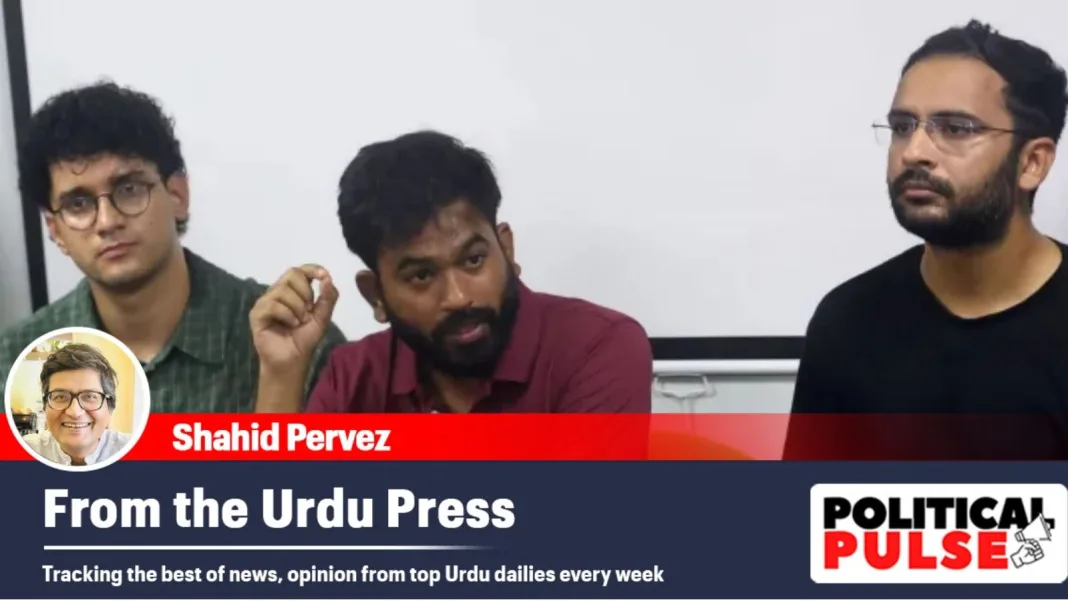
Recent weeks have seen a surge in public demonstrations across Europe and India, prompting editorial commentary in Urdu-language dailies regarding the nature of democratic dissent and the challenges facing modern governments. In Europe, widespread protests have erupted in countries including France, Albania, Italy, Spain, and Portugal. Reports indicate that students and youth are leading these demonstrations, citing grievances such as the rising cost of living, housing affordability, pension concerns, and deteriorating educational standards. The Hyderabad-based Siasat noted in its October 26 editorial that these protests challenge the perception that citizens in developed nations are universally content. The daily argued that the unrest reflects deep-seated public dissatisfaction with economic disparities and government policies, urging authorities globally to adopt more responsive, people-centric measures to address these grievances. In India, the discourse has centered on the political implications of protests and the government’s response to them. In its October 21 editorial, the New Delhi edition of Inquilab addressed comments made by RSS chief Mohan Bhagwat during his Vijayadashami address. Bhagwat suggested that recent protests in India and abroad—specifically mentioning France, Albania, Bangladesh, and Nepal—were part of a “storm from the West” orchestrated by foreign forces seeking to undermine India’s rise. Inquilab questioned the validity of labeling domestic agitations as “foreign conspiracies,” arguing that such rhetoric risks delegitimizing the democratic rights of citizens. The editorial emphasized that protests regarding electoral processes and government policies are integral to a democracy. It cautioned that dismissing dissent as “anti-national” could erode public confidence in institutions and close channels for dialogue. The publication urged the government to view youth-led protests as a signal to address systemic issues, such as unemployment and educational reform, rather than as a security threat. Separately, Inquilab covered the release of Cockroach Janta Party (CJP) co-conveners Saurav Das and Ashutosh Ranka from Tihar Jail following seven days of judicial custody. While the CJP has signaled a temporary pause in its activities ahead of the festive season, the editorial noted that broader political agitation remains active. The Congress-led INDIA bloc has scheduled a rally at Delhi’s Ramlila Maidan for November 1 to protest against the Special Intensive Revision (SIR) of electoral rolls and to demand the resignation of Chief Election Commissioner Gyanesh Kumar. Reflecting on the broader political climate, Inquilab concluded that while the debate over regime change and electoral integrity continues, the current wave of protests serves to heighten public awareness regarding democratic rights and duties. The daily maintained that in a democracy, the government’s willingness to engage with dissenting voices is essential for stability and national development.
News Desk is the editorial publishing account for Tringlobe Media News, covering breaking news, public affairs, entertainment, community developments and regional stories across Trinidad and Tobago, the Caribbean and internationally.