The key points are temporarily unavailable. You can still read the full Story below.
Main Points
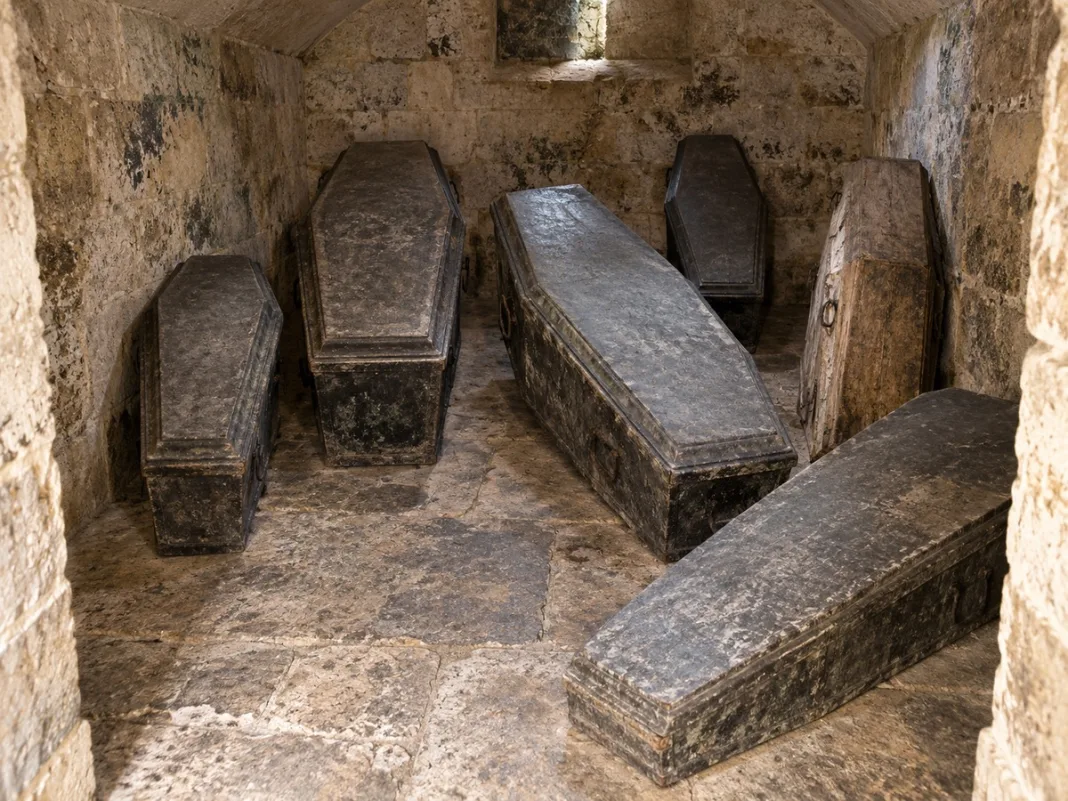
In the churchyard of Christ Church Parish Church overlooking Oistins sits an empty stone burial chamber with one of the strangest stories in Barbados history. Known as the Chase Vault, the tomb became famous through nineteenth-century accounts claiming that heavy coffins inside repeatedly changed position even after the entrance had been sealed.
Christ Church Parish Church says the mystery unfolded when the vault was opened on several occasions for burials and the leaden coffins already inside were reportedly found disturbed. In 1819, the situation attracted the attention of Barbados Governor Lord Combermere. According to the church’s historical account, the coffins were restored to their proper positions and the entrance was sealed, with the governor’s seal placed in the cement. When the vault was subsequently opened again, the seal was reportedly intact but the coffins were once more found displaced.
The story became part of Barbados folklore, but the distinction between documented history and later legend is important. Modern researchers have noted that surviving accounts do not conclusively prove that the famous disturbances occurred exactly as later stories described them. A peer-reviewed study by researchers Christina Welch and Niall Finneran examined the Chase Vault story within the social and cultural environment of nineteenth-century Barbados, describing it as a widely known tale in which coffins were reportedly found scattered when the sealed vault was reopened.
That wider context makes the legend especially revealing. Barbados at the time was a slave society marked by sharp inequalities and fears among the planter class about resistance and African-derived spiritual practices. Welch and Finneran argue that the way the Chase Vault story developed can therefore be studied not simply as a supernatural mystery, but as a reflection of the anxieties, beliefs and power relationships of the period in which it circulated.
Explanations for the alleged movements have ranged from natural forces to human interference. Christ Church Parish Church records one suggested possibility: gases associated with decomposition inside the lead coffins. Other writers have proposed flooding, seismic movement or deliberate disturbance, while sceptical investigations have questioned whether the dramatic version of the story can be independently verified at all. No explanation has achieved universal acceptance.
The setting itself has an unusually turbulent history. The present Christ Church Parish Church is the fifth place of worship associated with the congregation. An early wooden church near Dover was destroyed by flooding in 1669, later churches were lost to major hurricanes, and another building was destroyed by fire in 1935. Portions of the earlier structure were incorporated into the church that stands today.
The Chase Vault is now empty, but its survival gives Barbados a tangible link to a story that has been retold for roughly two centuries. Whether the moving coffins were the result of an unexplained physical event, exaggeration or evolving folklore, the vault remains valuable because of what the legend reveals about how history, fear and storytelling can become intertwined across generations.