The key points are temporarily unavailable. You can still read the full Story below.
Main Points
**International Media Scrutinized for Coverage of Nepal’s Bhote Kosi Flood** *Kathmandu, Nepal – September 2, 2026* – In the weeks following the catastrophic flooding of the Bhote Kosi river in August 2026, several Western news outlets have been criticized for the way they reported the disaster and its links to climate change. Two days after the flooding began, designers Bhavya Jain and Fatima Hamdani, both former Harvard classmates, posted a series of screenshots of headlines from mainstream Western media on Instagram. Using a red‑pen overlay reminiscent of Alexandra Bell’s “Counternarratives” series, they highlighted what they described as a “non‑committal tone” that, in their view, downplayed the connection between the flood, glacial collapse, and the broader climate crisis. The post attracted more than 32,000 likes and was accompanied by an article on their Substack platform, *Climate Without Borders*. In that article, Jain and Hamdani wrote that news agencies often quoted survivors’ “shock and panic” while giving less prominence to “experts’ warning from decades past on the climate crisis.” Jain told *Nepali Times* that “ambiguity is always dangerous because it shies away from responsibility,” and added that “it is the work of the media to bring attention to evidence that has been ignored for years.” **Scientific Context** Scientists have documented rapid glacial retreat and permafrost loss across the Himalayas as consequences of rising temperatures. According to research cited by the authors, the ice shelf on Langtang Lirung collapsed on 26 August 2026 after the underlying bedrock gave way. Himalayan experts have linked the bedrock failure to the loss of permafrost, noting that ice that previously cemented rock fractures melted as a result of record‑high temperatures on the Tibetan Plateau earlier in the summer. Some journalists, however, have expressed caution about attributing the flood solely to climate change. For example, a Reuters article posed the question, “Was climate change to blame for the Nepal floods?” and other commentators have described climate change as a “complex” factor that may interact with other causes of glacial collapse and landslides. **Human‑Settlement Factors** The high casualty rate—approaching 1,000 deaths with about 4,500 people reported missing—has also been linked to unregulated settlements along dynamic floodplains. Critics argue that while climate change may have contributed to glacial instability, the vulnerability of affected communities is also a product of settlement patterns and infrastructure decisions. A statement from Kathmandu‑based visual storytelling platform photo.circle described the climate crisis as “produced within a western capitalist imperialist world order that continues to push us all to the brink and beyond.” Hamdani added that “the aid sent by western governments is disproportionate to their emissions, it is they who have caused these fragile ecosystems to collapse.” **Media Coverage and Public Interest** Google Trends data indicated a sharp spike in worldwide searches for “Nepal” the day after the floodwaters rose, followed by an 80 percent decline in subsequent weeks. Observers note that international attention often wanes after the immediate aftermath of a disaster, a pattern also seen after the 2015 Nepal earthquake. **Calls for Accountability** The debate over how to frame the Bhote Kosi flood reflects broader discussions about responsibility for climate‑related disasters. Ishan Tharoor, writing in *The New Yorker*, referred to the event as “the floods Nepal didn’t cause,” emphasizing the distinction between natural hazards and human‑induced climate change. Jain and Hamdani argue that media coverage should move beyond describing the disaster to examining the systemic factors—such as historical emissions and development policies—that increase risk for low‑emitting countries like Nepal. **Support for Affected Communities** The Nepali government has established a Prime Minister’s Disaster Relief Fund to aid those impacted by the flood. Donations can be made through the official channel, with additional information available on the government’s website. *By Kaede Polkinghorne, intern, Nepali Times* Article and image source: nepalitimes.com
**International Media Scrutinized for Coverage of Nepal’s Bhote Kosi Flood**
*Kathmandu, Nepal – September 2, 2026* – In the weeks following the catastrophic flooding of the Bhote Kosi river in August 2026, several Western news outlets have been criticized for the way they reported the disaster and its links to climate change.
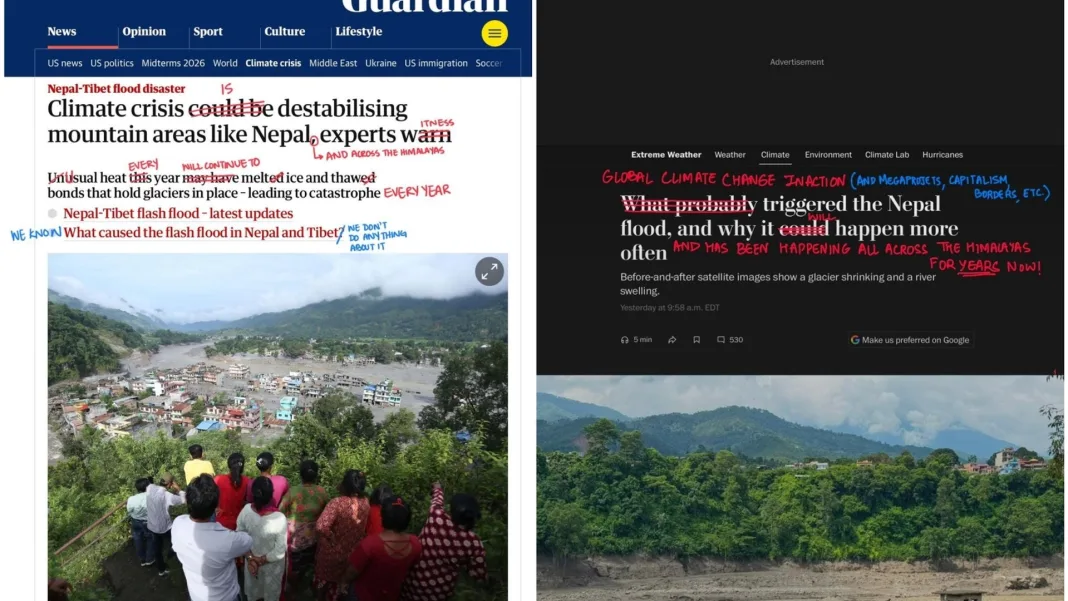
Two days after the flooding began, designers Bhavya Jain and Fatima Hamdani, both former Harvard classmates, posted a series of screenshots of headlines from mainstream Western media on Instagram. Using a red‑pen overlay reminiscent of Alexandra Bell’s “Counternarratives” series, they highlighted what they described as a “non‑committal tone” that, in their view, downplayed the connection between the flood, glacial collapse, and the broader climate crisis. The post attracted more than 32,000 likes and was accompanied by an article on their Substack platform, *Climate Without Borders*.
In that article, Jain and Hamdani wrote that news agencies often quoted survivors’ “shock and panic” while giving less prominence to “experts’ warning from decades past on the climate crisis.” Jain told *Nepali Times* that “ambiguity is always dangerous because it shies away from responsibility,” and added that “it is the work of the media to bring attention to evidence that has been ignored for years.”
**Scientific Context**
Scientists have documented rapid glacial retreat and permafrost loss across the Himalayas as consequences of rising temperatures. According to research cited by the authors, the ice shelf on Langtang Lirung collapsed on 26 August 2026 after the underlying bedrock gave way. Himalayan experts have linked the bedrock failure to the loss of permafrost, noting that ice that previously cemented rock fractures melted as a result of record‑high temperatures on the Tibetan Plateau earlier in the summer.
Some journalists, however, have expressed caution about attributing the flood solely to climate change. For example, a Reuters article posed the question, “Was climate change to blame for the Nepal floods?” and other commentators have described climate change as a “complex” factor that may interact with other causes of glacial collapse and landslides.
**Human‑Settlement Factors**
The high casualty rate—approaching 1,000 deaths with about 4,500 people reported missing—has also been linked to unregulated settlements along dynamic floodplains. Critics argue that while climate change may have contributed to glacial instability, the vulnerability of affected communities is also a product of settlement patterns and infrastructure decisions.
A statement from Kathmandu‑based visual storytelling platform photo.circle described the climate crisis as “produced within a western capitalist imperialist world order that continues to push us all to the brink and beyond.” Hamdani added that “the aid sent by western governments is disproportionate to their emissions, it is they who have caused these fragile ecosystems to collapse.”
**Media Coverage and Public Interest**
Google Trends data indicated a sharp spike in worldwide searches for “Nepal” the day after the floodwaters rose, followed by an 80 percent decline in subsequent weeks. Observers note that international attention often wanes after the immediate aftermath of a disaster, a pattern also seen after the 2015 Nepal earthquake.
**Calls for Accountability**
The debate over how to frame the Bhote Kosi flood reflects broader discussions about responsibility for climate‑related disasters. Ishan Tharoor, writing in *The New Yorker*, referred to the event as “the floods Nepal didn’t cause,” emphasizing the distinction between natural hazards and human‑induced climate change. Jain and Hamdani argue that media coverage should move beyond describing the disaster to examining the systemic factors—such as historical emissions and development policies—that increase risk for low‑emitting countries like Nepal.
**Support for Affected Communities**
The Nepali government has established a Prime Minister’s Disaster Relief Fund to aid those impacted by the flood. Donations can be made through the official channel, with additional information available on the government’s website.
News Desk is the editorial publishing account for Tringlobe Media News, covering breaking news, public affairs, entertainment, community developments and regional stories across Trinidad and Tobago, the Caribbean and internationally.