The key points are temporarily unavailable. You can still read the full Story below.
Main Points
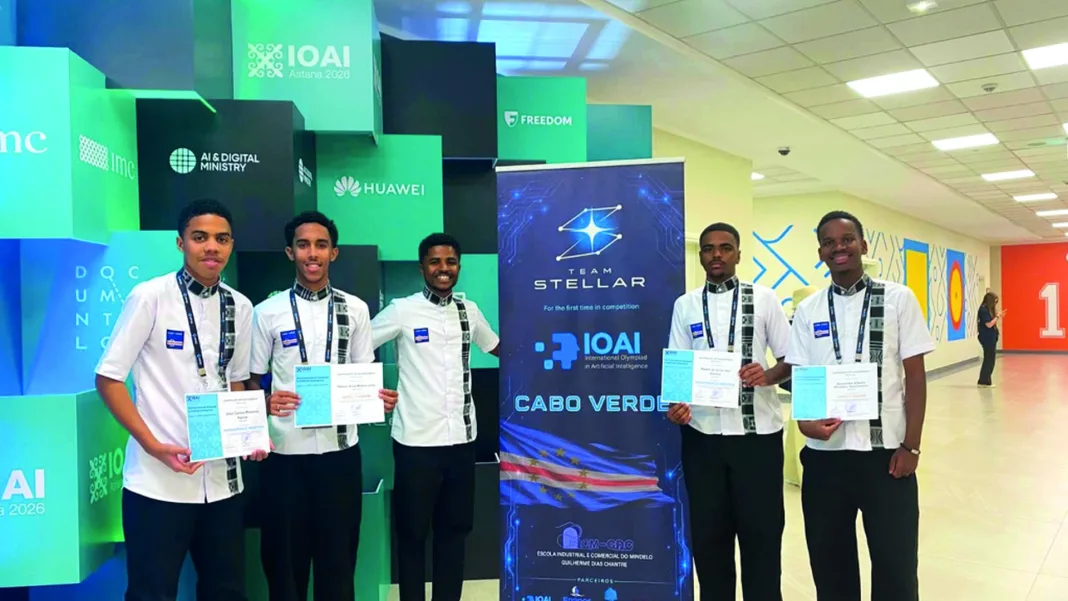
**Cabo Verde Debuts with Medal Wins at International AI Olympiad in Astana** *Astana, Kazakhstan – 8 August 2026* – A team of four high‑school students from Cabo Verde, competing under the name “Stellar CV,” earned two bronze medals and two honorable mentions at the 2026 International Olympiad of Artificial Intelligence (IOAI). It was the island nation’s first participation in the competition. The IOAI, founded in 2024, is a global contest for secondary‑school students under 20 that challenges participants to develop code and machine‑learning models for real‑world problems in computer vision, natural‑language processing and related fields. The 2026 edition, held in Astana from 2 to 8 August, attracted more than 500 contestants from 108 countries, surpassing the 300 participants from 61 nations in the 2025 event in Beijing. **Background and preparation** The initiative began at the Escola Industrial e Comercial do Mindelo (EICM) in the capital city of Mindelo. Jorge Michael Rocha, the school’s ICT coordinator, learned of the IOAI through a former teammate of a Madagascar team who had met Pedro da Cruz dos Santos at the 2024 FIRST Global Challenge in Athens. Santos, then a 12th‑grade student, had already taken part in four editions of the robotics competition and was preparing for a fifth appearance in South Korea in October. Motivated by the prospect of representing Cabo Verde, Rocha and the school administration pursued accreditation for the country, which had never before taken part in the IOAI. After demonstrating that EICM possessed the technical capacity to organize a national team, the school was approved as the national organizing entity. A nationwide selection process, overseen by the EduSpace organization that supports the IOAI, attracted nearly 500 students from across the archipelago. The competition began with a theoretical test designed to encourage broad participation, then progressed through increasingly demanding stages. Ultimately, 11 finalists (three girls and eight boys) were chosen for further testing and English‑language interviews, a prerequisite given that all IOAI activities are conducted in English. From this pool, four students were selected to form Team Stellar CV: Alexandre Nascimento, José Aguiar, Pedro da Cruz dos Santos (all from EICM) and Nilson Leite of the Escola Secundária Polivalente Cesaltina Ramos in Praia. The team was mentored by Jorge Michael Rocha, along with teachers Stephan Rocha and Estefânio Silva. **Training challenges** The team had only about a month of intensive preparation between late June and July, constrained by the national school exam schedule. Training covered Python programming, machine‑learning techniques, model training and large‑scale data analysis—subjects not yet part of the standard curriculum in Cabo Verde. Rocha noted, “These topics are not taught in our schools, so we had to learn them ourselves first in order to teach the students.” Mid‑preparation, the IOAI’s host country changed from the United Arab Emirates to Kazakhstan for security reasons. The shift required the team to obtain a Kazakh visa through the Portuguese embassy in Lisbon, adding logistical and financial hurdles. The team secured travel funding through an IOAI‑sponsored grant for countries lacking resources, as well as contributions from local firms (NOSI, ENAPOR, MOAVE), the insurance provider IMPAR, and a crowdfunding campaign supported by expatriate Isaura Frances. **Competition performance** In Astana, the Stellar CV team joined more than 500 peers from around the world for a week of individual and team challenges. Tasks included image‑pattern recognition, handwriting authentication and chronological reconstruction of message threads, using libraries such as PyTorch and scikit‑learn. The team’s first group challenge placed them outside the top ten, but they recovered in subsequent individual six‑hour programming tests. Pedro da Cruz dos Santos described the experience as “a succession of decisions—read, interpret, understand the problem, build the algorithm, code, test, submit—often under pressure and with moments of near panic.” Ultimately, Alexandre Nascimento and Nilson Leite each secured third place, earning bronze medals, while José Aguiar and Pedro da Cruz dos Santos received honorable mentions. The results marked a “remarkable debut” for a country without a formal AI education program, positioning Cabo Verde alongside more established competitors. **Future plans** Rocha intends to maintain Cabo Verde’s presence at the IOAI, which will be hosted in Singapore in 2027. He plans to begin training earlier, identify programming talent across schools Article and image source: expressodasilhas.cv
**Cabo Verde Debuts with Medal Wins at International AI Olympiad in Astana**
*Astana, Kazakhstan – 8 August 2026* – A team of four high‑school students from Cabo Verde, competing under the name “Stellar CV,” earned two bronze medals and two honorable mentions at the 2026 International Olympiad of Artificial Intelligence (IOAI). It was the island nation’s first participation in the competition.
The IOAI, founded in 2024, is a global contest for secondary‑school students under 20 that challenges participants to develop code and machine‑learning models for real‑world problems in computer vision, natural‑language processing and related fields. The 2026 edition, held in Astana from 2 to 8 August, attracted more than 500 contestants from 108 countries, surpassing the 300 participants from 61 nations in the 2025 event in Beijing.
**Background and preparation**
The initiative began at the Escola Industrial e Comercial do Mindelo (EICM) in the capital city of Mindelo. Jorge Michael Rocha, the school’s ICT coordinator, learned of the IOAI through a former teammate of a Madagascar team who had met Pedro da Cruz dos Santos at the 2024 FIRST Global Challenge in Athens. Santos, then a 12th‑grade student, had already taken part in four editions of the robotics competition and was preparing for a fifth appearance in South Korea in October.
Motivated by the prospect of representing Cabo Verde, Rocha and the school administration pursued accreditation for the country, which had never before taken part in the IOAI. After demonstrating that EICM possessed the technical capacity to organize a national team, the school was approved as the national organizing entity.
A nationwide selection process, overseen by the EduSpace organization that supports the IOAI, attracted nearly 500 students from across the archipelago. The competition began with a theoretical test designed to encourage broad participation, then progressed through increasingly demanding stages. Ultimately, 11 finalists (three girls and eight boys) were chosen for further testing and English‑language interviews, a prerequisite given that all IOAI activities are conducted in English.
From this pool, four students were selected to form Team Stellar CV: Alexandre Nascimento, José Aguiar, Pedro da Cruz dos Santos (all from EICM) and Nilson Leite of the Escola Secundária Polivalente Cesaltina Ramos in Praia. The team was mentored by Jorge Michael Rocha, along with teachers Stephan Rocha and Estefânio Silva.
**Training challenges**
The team had only about a month of intensive preparation between late June and July, constrained by the national school exam schedule. Training covered Python programming, machine‑learning techniques, model training and large‑scale data analysis—subjects not yet part of the standard curriculum in Cabo Verde. Rocha noted, “These topics are not taught in our schools, so we had to learn them ourselves first in order to teach the students.”
Mid‑preparation, the IOAI’s host country changed from the United Arab Emirates to Kazakhstan for security reasons. The shift required the team to obtain a Kazakh visa through the Portuguese embassy in Lisbon, adding logistical and financial hurdles. The team secured travel funding through an IOAI‑sponsored grant for countries lacking resources, as well as contributions from local firms (NOSI, ENAPOR, MOAVE), the insurance provider IMPAR, and a crowdfunding campaign supported by expatriate Isaura Frances.
**Competition performance**
In Astana, the Stellar CV team joined more than 500 peers from around the world for a week of individual and team challenges. Tasks included image‑pattern recognition, handwriting authentication and chronological reconstruction of message threads, using libraries such as PyTorch and scikit‑learn.
The team’s first group challenge placed them outside the top ten, but they recovered in subsequent individual six‑hour programming tests. Pedro da Cruz dos Santos described the experience as “a succession of decisions—read, interpret, understand the problem, build the algorithm, code, test, submit—often under pressure and with moments of near panic.”
Ultimately, Alexandre Nascimento and Nilson Leite each secured third place, earning bronze medals, while José Aguiar and Pedro da Cruz dos Santos received honorable mentions. The results marked a “remarkable debut” for a country without a formal AI education program, positioning Cabo Verde alongside more established competitors.
**Future plans**
Rocha intends to maintain Cabo Verde’s presence at the IOAI, which will be hosted in Singapore in 2027. He plans to begin training earlier, identify programming talent across schools
News Desk is the editorial publishing account for Tringlobe Media News, covering breaking news, public affairs, entertainment, community developments and regional stories across Trinidad and Tobago, the Caribbean and internationally.