The key points are temporarily unavailable. You can still read the full Story below.
Main Points
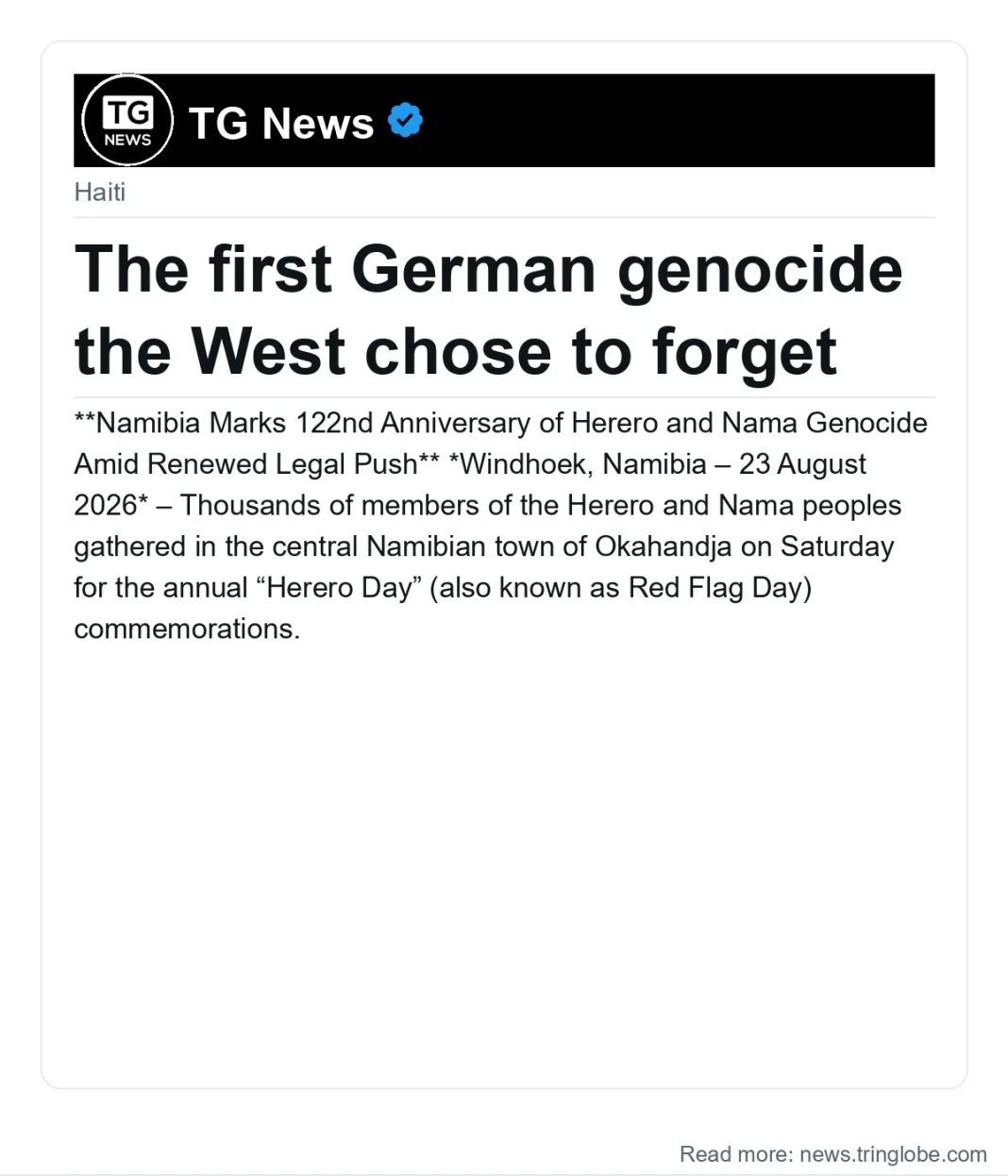
**Namibia Marks 122nd Anniversary of Herero and Nama Genocide Amid Renewed Legal Push** *Windhoek, Namibia – 23 August 2026* – Thousands of members of the Herero and Nama peoples gathered in the central Namibian town of Okahandja on Saturday for the annual “Herero Day” (also known as Red Flag Day) commemorations. The ceremony, which honors the late chief Samuel Maharero, also served as a platform for renewed calls for reparations and legal accountability for the atrocities committed by German colonial forces between 1904 and 1908. **Historical background** During the early 20th‑century German colonial period in what was then German South West Africa, an uprising by the Herero in 1904 was followed by a brutal counter‑campaign ordered by General Lothar von Trotha. In an October 1904 directive, von Trotha instructed that “every Herero, with or without a gun… will be shot.” Subsequent actions forced large numbers of Herero and later Nama civilians into the arid Omaheke Desert, where wells were poisoned and access to water was denied. Survivors were later interned in concentration camps such as the one on Shark Island, where they were subjected to forced labour, harsh conditions and medical experiments. Estimates compiled by historians and legal scholars place the death toll at roughly 70,000 people, representing about 80 % of the Herero population and 50 % of the Nama population. The United Nations and several academic bodies have described the events as the first genocide of the 20th century. **2021 joint declaration and its critics** In May 2021, after six years of bilateral negotiations, the governments of Germany and Namibia signed a joint declaration in which Germany acknowledged the events as “genocide from today’s perspective.” The agreement stipulated a €1.1 billion contribution from Germany over a 30‑year period for development projects in Namibia. German officials framed the contribution as a voluntary act of reconciliation rather than a legally binding reparations payment, citing the absence of a genocide convention at the time of the atrocities. Critics, including representatives of the Ovaherero Traditional Authority (OTA) and the Nama Traditional Leaders Association (NTLA), argue that the 2021 declaration excluded the direct descendants of the victims and therefore violated Namibian constitutional obligations to protect the rights of its indigenous peoples. In 2023, the OTA and NTLA filed a legal challenge in the Namibian High Court seeking to invalidate the joint declaration on the grounds that it was concluded without the participation of the affected communities. **Recent developments** The August 2026 commemorations in Okahandja were marked by speeches emphasizing the ongoing struggle for justice. Leaders of the OTA and NTLA reiterated their demand that any settlement include direct reparations to the descendants of the victims, rather than state‑to‑state development aid. In August 2026, Amnesty International submitted an amicus curiae brief to the Namibian High Court, supporting the claimants’ position that international law recognizes the right of indigenous communities to seek reparations for genocide, irrespective of the timing of the legal instruments that later codified the crime. The filing aligns with broader efforts by the African Union (AU) and the Caribbean Community (CARICOM) to incorporate colonial-era atrocities into international legal frameworks as crimes against humanity. **German response** German officials have maintained that the 2021 joint declaration reflects a “historically informed” acknowledgment of past wrongs while emphasizing that the contribution is a development partnership rather than a legal admission of liability. The German Foreign Ministry has indicated that the matter will be reviewed in light of the ongoing legal proceedings in Namibia, but has not announced any change to the terms of the original agreement. **International context** The case highlights a contrast with Germany’s post‑World‑War II reparations programme for Holocaust survivors, which involved direct, legally enforceable compensation. Legal scholars note that Germany’s reliance on the principle of non‑retroactivity—arguing that the 1948 Genocide Convention did not exist at the time of Article and image source: haitisun.com
**Namibia Marks 122nd Anniversary of Herero and Nama Genocide Amid Renewed Legal Push**
*Windhoek, Namibia – 23 August 2026* – Thousands of members of the Herero and Nama peoples gathered in the central Namibian town of Okahandja on Saturday for the annual “Herero Day” (also known as Red Flag Day) commemorations. The ceremony, which honors the late chief Samuel Maharero, also served as a platform for renewed calls for reparations and legal accountability for the atrocities committed by German colonial forces between 1904 and 1908.
**Historical background**
During the early 20th‑century German colonial period in what was then German South West Africa, an uprising by the Herero in 1904 was followed by a brutal counter‑campaign ordered by General Lothar von Trotha. In an October 1904 directive, von Trotha instructed that “every Herero, with or without a gun… will be shot.” Subsequent actions forced large numbers of Herero and later Nama civilians into the arid Omaheke Desert, where wells were poisoned and access to water was denied. Survivors were later interned in concentration camps such as the one on Shark Island, where they were subjected to forced labour, harsh conditions and medical experiments.
Estimates compiled by historians and legal scholars place the death toll at roughly 70,000 people, representing about 80 % of the Herero population and 50 % of the Nama population. The United Nations and several academic bodies have described the events as the first genocide of the 20th century.
**2021 joint declaration and its critics**
In May 2021, after six years of bilateral negotiations, the governments of Germany and Namibia signed a joint declaration in which Germany acknowledged the events as “genocide from today’s perspective.” The agreement stipulated a €1.1 billion contribution from Germany over a 30‑year period for development projects in Namibia. German officials framed the contribution as a voluntary act of reconciliation rather than a legally binding reparations payment, citing the absence of a genocide convention at the time of the atrocities.
Critics, including representatives of the Ovaherero Traditional Authority (OTA) and the Nama Traditional Leaders Association (NTLA), argue that the 2021 declaration excluded the direct descendants of the victims and therefore violated Namibian constitutional obligations to protect the rights of its indigenous peoples. In 2023, the OTA and NTLA filed a legal challenge in the Namibian High Court seeking to invalidate the joint declaration on the grounds that it was concluded without the participation of the affected communities.
**Recent developments**
The August 2026 commemorations in Okahandja were marked by speeches emphasizing the ongoing struggle for justice. Leaders of the OTA and NTLA reiterated their demand that any settlement include direct reparations to the descendants of the victims, rather than state‑to‑state development aid.
In August 2026, Amnesty International submitted an amicus curiae brief to the Namibian High Court, supporting the claimants’ position that international law recognizes the right of indigenous communities to seek reparations for genocide, irrespective of the timing of the legal instruments that later codified the crime. The filing aligns with broader efforts by the African Union (AU) and the Caribbean Community (CARICOM) to incorporate colonial-era atrocities into international legal frameworks as crimes against humanity.
**German response**
German officials have maintained that the 2021 joint declaration reflects a “historically informed” acknowledgment of past wrongs while emphasizing that the contribution is a development partnership rather than a legal admission of liability. The German Foreign Ministry has indicated that the matter will be reviewed in light of the ongoing legal proceedings in Namibia, but has not announced any change to the terms of the original agreement.
**International context**
The case highlights a contrast with Germany’s post‑World‑War II reparations programme for Holocaust survivors, which involved direct, legally enforceable compensation. Legal scholars note that Germany’s reliance on the principle of non‑retroactivity—arguing that the 1948 Genocide Convention did not exist at the time of
News Desk is the editorial publishing account for Tringlobe Media News, covering breaking news, public affairs, entertainment, community developments and regional stories across Trinidad and Tobago, the Caribbean and internationally.