The key points are temporarily unavailable. You can still read the full Story below.
Main Points
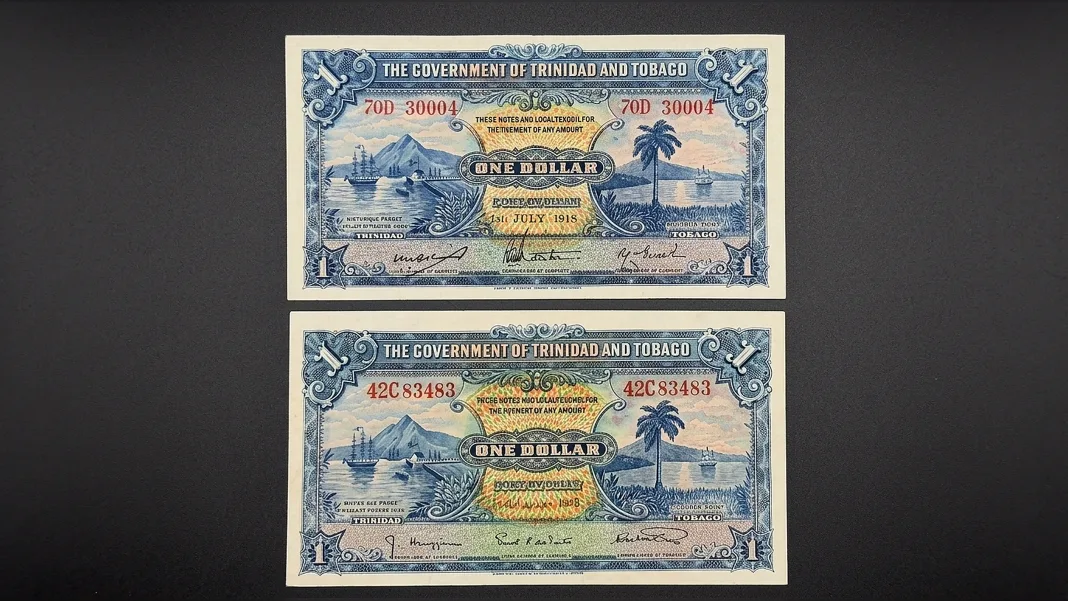
For more than eighty years, these delicate fragments of history have quietly defied the passage of time. Issued in 1939 and 1948, they emerged from a colonial Trinidad and Tobago still governed under the British Crown, passing through the hands of merchants, labourers, civil servants, and families navigating an uncertain world shaped by war and change. Most notes of this era were worn away by decades of use, their stories gradually fading from memory. Yet, these remarkable survivors endured. Their colors remain vivid, their intricate engravings sharply defined, preserving a vision of Port of Spain’s harbour as it appeared to generations long gone. Adding to their fascination, one bears an attractive radar serial number—a subtle numerical rarity appreciated by discerning collectors. But their true significance lies beyond their scarcity. They are tangible links to another age; silent witnesses to the everyday lives, ambitions, and transactions that helped shape a nation. Today, more than eight decades later, they stand not merely as currency, but as enduring custodians of Trinidad and Tobago’s monetary heritage.
For more than eighty years, these delicate fragments of history have quietly defied the passage of time. Issued in 1939 and 1948, they emerged from a colonial Trinidad and Tobago still governed under the British Crown, passing through the hands of merchants, labourers, civil servants, and families navigating an uncertain world shaped by war and change. Most notes of this era were worn away by decades of use, their stories gradually fading from memory. Yet, these remarkable survivors endured. Their colors remain vivid, their intricate engravings sharply defined, preserving a vision of Port of Spain’s harbour as it appeared to generations long gone. Adding to their fascination, one bears an attractive radar serial number—a subtle numerical rarity appreciated by discerning collectors. But their true significance lies beyond their scarcity. They are tangible links to another age; silent witnesses to the everyday lives, ambitions, and transactions that helped shape a nation. Today, more than eight decades later, they stand not merely as currency, but as enduring custodians of Trinidad and Tobago’s monetary heritage.
News Desk is the editorial publishing account for Tringlobe Media News, covering breaking news, public affairs, entertainment, community developments and regional stories across Trinidad and Tobago, the Caribbean and internationally.